 English
 French
 German
 Italian
 Polish
 Russian
 Spanish
Quick answer: Vape puff count testing should be treated as a controlled verification exercise, not as a prediction of how long every consumer will use a device. Wholesale buyers should ask the supplier to define the puffing regime, device cut-off criteria, sample size, test environment, liquid and battery end points, and the evidence behind the advertised claim.
For wholesalers, distributors and importers, a high puff-count number can influence portfolio positioning, landed cost and customer expectations. However, two devices carrying the same number may have been evaluated under different conditions. A useful supplier review therefore starts with the test method and records, rather than the number printed on a package.
What does vape puff count testing measure?
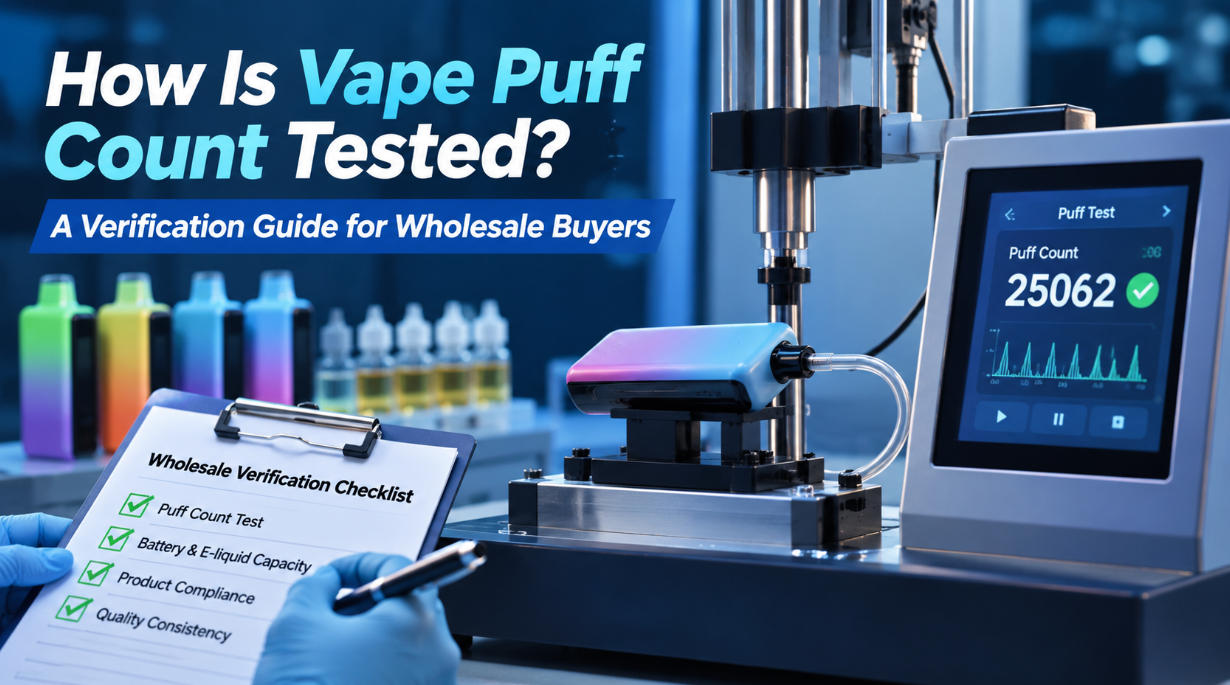
In a laboratory or production-verification setting, a vaping machine draws repeatable puffs from a device under a defined regime. The test can record how many cycles the device completes before a pre-agreed end point is reached. Depending on the project, the end point may involve e-liquid depletion, battery behaviour, output stability, automatic device protection or another documented criterion.
The result is conditional on the method. Puff duration, puff volume, interval, airflow, device orientation, ambient conditions and activation behaviour can all influence the outcome. A test report should therefore state the method and configuration clearly. A puff number without those details is difficult for a buyer to compare or audit.
Standards and methods buyers may encounter
ISO 20768:2018 specifies requirements for a routine analytical vaping machine and provides a framework for controlled aerosol generation. CORESTA Recommended Method No. 81 is another commonly cited reference for routine analytical machine vaping of e-cigarettes. These references help laboratories create repeatable conditions, but citing a standard does not by itself prove that a particular commercial puff claim is accurate.
Buyers should ask which method was used, whether the supplier changed any parameters, what the changes were, and why the chosen regime fits the product being evaluated. Destination-market rules, test purposes and product designs can differ, so the final verification plan should be agreed for the exact model and version.
Why advertised puff counts can differ from real-world use
- Draw length and intensity: longer or stronger user draws may consume more liquid and energy per puff.
- Time between puffs: the interval affects coil temperature, liquid replenishment and battery load.
- Airflow setting: an adjustable-airflow device can operate differently across settings.
- Coil and wick behaviour: liquid delivery and heating consistency affect output over the test.
- Battery management: cut-off logic, voltage range and recharge behaviour affect usable cycles.
- Environmental conditions: temperature, storage history and device orientation can influence performance.
- End-point definition: “stopped producing aerosol” and “output fell below an agreed threshold” are not the same criterion.
This is why buyers should avoid presenting laboratory puff count as a guaranteed consumer usage duration. The defensible claim is the result obtained under the stated method and conditions.
What should be included in a puff-count test report?
| Report section | What the buyer should check |
|---|---|
| Product identity | Model, version, batch, battery, coil, e-liquid configuration and firmware where applicable |
| Sample plan | Number of units, sampling source and treatment of invalid or failed samples |
| Puffing regime | Machine, puff duration, volume, interval, profile and activation method |
| Environment | Temperature, humidity, conditioning time and device orientation |
| Recharge conditions | Whether and when the device was recharged, plus charger and cut-off conditions |
| End point | Documented rule for stopping the test and classifying completion or failure |
| Results | Individual-unit data, summary statistics, abnormalities and observations |
| Approval | Test date, responsible person, method revision and report revision |
A practical verification workflow for wholesale buyers
1. Freeze the exact product configuration
Confirm the device, battery, coil, e-liquid, airflow and software version before testing. Data from a similar model should not be substituted for the product being purchased.
2. Agree the method before accepting the claim
Put the puffing regime, sample plan and end-point definition into the specification or test protocol. If a method is modified, record the deviation rather than referring only to a standard name.
3. Review unit-level results
An average can hide early failures. Ask for individual-unit data and the reason for any excluded sample. The distribution of results is often more useful for supplier evaluation than one headline number.
4. Compare the claim with other product evidence
Review battery capacity, e-liquid capacity, power behaviour and coil design as a system. Our guide to what is inside a vape explains the main components, while the vape manufacturer quality-control checklist covers broader supplier evidence.
5. Repeat verification after material changes
A change to liquid, coil, airflow, battery, electronics or production process may affect performance. Buyers should define which changes trigger re-sampling or re-testing.
Common mistakes when comparing high-puff products
- Comparing package claims without comparing test regimes.
- Accepting one prototype result as proof of mass-production consistency.
- Ignoring device-version and batch information.
- Using consumer review duration as a laboratory metric.
- Assuming a larger battery or liquid volume automatically validates the final claim.
- Failing to define what counts as a completed puff or test failure.
How supplier quality control supports puff-count consistency
Puff testing is only one part of product verification. Incoming-component controls, filling accuracy, coil and wick consistency, electrical testing, leak control and traceability all influence whether production units behave like approved samples. Buyers evaluating a disposable vape factory should connect puff-count evidence to the supplier’s wider quality system.
FAQ
Does a laboratory puff count guarantee consumer usage?
No. It documents performance under defined test conditions. Individual draw behaviour and operating conditions vary.
Is a higher advertised puff count always better?
Not necessarily. Buyers should evaluate claim evidence, output consistency, product design, compliance, cost and portfolio fit together.
Should buyers request third-party testing?
The appropriate level of verification depends on the market, claim, risk and purchasing agreement. Buyers may use supplier data, independent testing or both, but the exact product and method must be identifiable.
Can one test report cover multiple flavors or versions?
Do not assume so. The buyer should document which configurations are represented and whether differences could affect device performance.
Build a verifiable high-puff product specification
ROCKMEVAPE works with wholesale and OEM/ODM buyers on product specifications, sampling and documentation requirements. Contact ROCKMEVAPE to discuss the exact model, target market and puff-count evidence required for your sourcing project.