 English
 French
 German
 Italian
 Polish
 Russian
 Spanish
Quick answer: The right disposable vape brands for a wholesaler are not simply the names with the largest online catalogues or the highest advertised puff counts. A viable brand must match the destination market, provide verifiable authorization and product records, deliver consistent batches, and support traceability after the sale. In the United States, buyers must verify the exact product—not merely the brand—against current FDA marketing authorization data. In Europe, rules differ by country, and several markets prohibit single-use vapes.
This guide is written for wholesalers, distributors, importers and private-label buyers comparing branded disposable products for Europe and the United States. It is a procurement framework, not a consumer ranking or a claim that any named product is legal in every market.
What buyers mean when they search for disposable vape brands
The search phrase usually combines three commercial questions:
- Demand: Which names do adult customers already recognize?
- Supply: Which manufacturers or authorized distributors can provide genuine, repeatable inventory?
- Market access: Which exact SKUs can legally be imported, distributed and sold in the destination jurisdiction?
Most competing brand lists answer only the first question. They present long catalogues, model names, flavor counts and puff claims, but provide little help with authorization, country restrictions, notification status, batch documents or counterfeit risk. For a B2B buyer, those omissions can be more important than brand popularity.
Brand recognition is not the same as legal market access
Names such as Elf Bar, Lost Mary, Geek Bar, Vozol and other disposable brands frequently appear in retailer and distributor catalogues. That visibility may indicate consumer recognition, but it does not establish that every model, flavor or nicotine strength can lawfully be sold in a particular country.
A brand can operate multiple product families, factories, importers and regional packaging versions. Legal status attaches to the exact product and market configuration. Buyers should record the full SKU, manufacturer, responsible economic operator, nicotine strength, liquid volume, batch code and destination country before making a purchase decision.
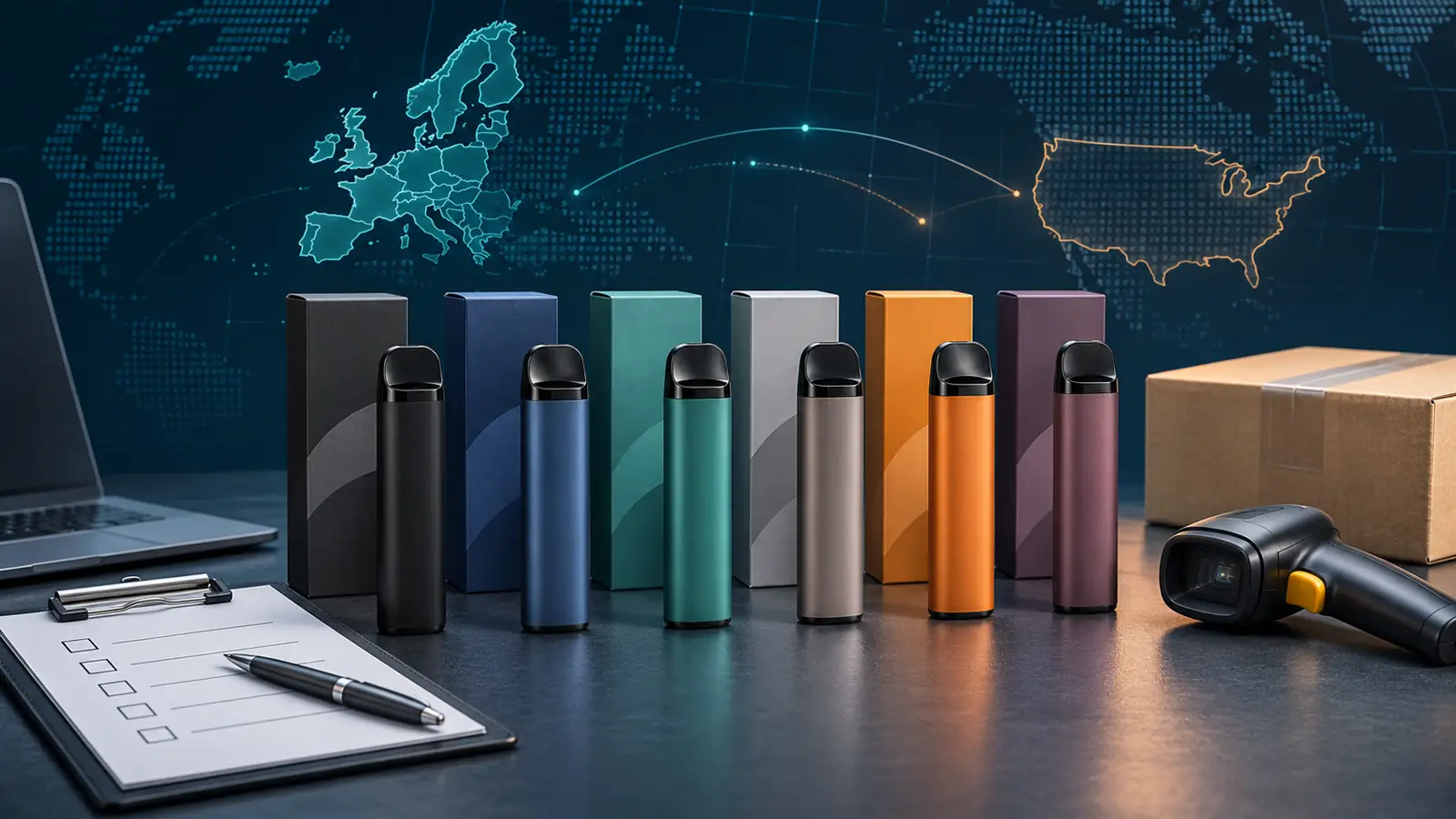
United States: check the exact product in FDA records
The U.S. Food and Drug Administration states that e-cigarettes with marketing authorization are the products that may currently be lawfully sold in the United States. A pending application is not a legal safe harbor. FDA has also issued enforcement actions involving unauthorized flavored disposable products, including products sold under well-known brand names.
For every proposed U.S. SKU, search the FDA’s market-and-distribute resources and Searchable Tobacco Products Database. Match the manufacturer and exact product name. Do not accept “FDA registered,” “PMTA submitted” or a supplier-created certificate as a substitute for a marketing authorization order.
Importers and distributors must also screen applicable state and local requirements. Flavor restrictions, product directories, licensing, tax and shipping rules can vary. Federal authorization alone does not complete a state-by-state compliance review.
Europe: screen each destination country
Article 20 of the EU Tobacco Products Directive provides a common framework for nicotine-containing electronic cigarettes, including notification, ingredient, nicotine-strength, refill-container and information requirements. The European Commission’s electronic-cigarette guidance is a useful starting point, but it is not the end of the review.
National measures matter. Belgium has prohibited disposable electronic cigarettes since 1 January 2025. France prohibits specified prefilled devices that cannot be refilled, including when the battery is rechargeable, under Article L3513-5-1 of the Public Health Code. The United Kingdom banned the sale and supply of single-use vapes from 1 June 2025; the official business guidance explains that the rule applies to online and physical sales and to nicotine and nicotine-free products.
Other European countries may have different restrictions, notification processes, taxes, flavors, packaging rules or proposed measures. Read our related guide on whether disposable vapes can still be sold in Europe before treating “EU compliant” as a universal claim.
A seven-point scorecard for comparing disposable vape brands
| Evaluation area | Evidence to request | Warning signs |
|---|---|---|
| Market eligibility | Exact authorization, notification or product-directory record for the destination | Generic “compliance certificate” with no matching SKU |
| Supplier authority | Brand-owner confirmation, distribution agreement and traceable invoices | Refusal to identify the upstream supplier |
| Product identity | Model, nicotine strength, liquid volume, packaging revision and barcode list | Mixed packaging or model names within one lot |
| Batch quality | Lot-specific inspection and test records with sampling method | Only an undated marketing brochure or one universal report |
| Claims | Defined test method for puff count, battery and leakage claims | Large headline figures without conditions or cut-off criteria |
| Traceability | Lot code, manufacture date, responsible operator and recall contact | No usable batch code or importer identity |
| Commercial support | Defect policy, lead time, replenishment plan and territory terms | Price pressure before samples and documentation are reviewed |
1. Verify the brand owner and sales channel
Start with the brand’s official contact route. Ask the brand owner to confirm whether the supplier is an authorized factory, distributor or reseller for the proposed territory. Compare company names, bank beneficiary details, invoice entities and email domains. For high-risk orders, conduct a live video inspection or independent factory and warehouse audit.
2. Match documents to the exact SKU
A report for one model does not validate another model under the same brand. Check model codes, photographs, electrical specifications, liquid formulation, nicotine concentration and packaging version across the quotation, samples, laboratory records and shipment documents. If any item changes, ask whether the market notification or authorization must also change.
3. Evaluate product claims as testable specifications
Puff count is influenced by puff duration, draw strength, power mode, cut-off criteria and user behavior. Treat it as a test result under stated conditions—not a guaranteed number for every consumer. Our guide to vape puff-count testing explains the questions buyers should ask about the test regime and sample size.
4. Inspect samples and production lots separately
Approval samples help assess design and function, but they do not prove that mass production will be identical. Define acceptance criteria for leakage, activation, charging, battery condition, labeling, packaging and cosmetic defects. State the sampling plan and who pays for inspection, rework or replacement when a lot fails.
5. Check authenticity and counterfeit controls
Ask how serial numbers or verification codes are generated, whether codes can be checked in bulk, and who investigates duplicates. Confirm that authentication pages use the brand’s genuine domain. A scratch code alone is weak evidence if the code database or supply chain cannot be verified.
6. Calculate landed risk, not just unit price
Compare the total cost of compliant packaging, testing, notification, tax, customs, freight, insurance, warehousing, damaged stock and potential returns. A lower unit price can become expensive if the product is detained, delisted or rejected. Use the eight-step bulk vape sourcing process to structure quotation and sample comparisons.
7. Plan for recalls and rule changes
Before ordering, assign responsibility for complaint handling, serious-incident escalation, product withdrawal and customer notification. Include a change-control clause covering formula, coil, battery, firmware, packaging and manufacturing-site changes. Monitor regulators after the order because product eligibility can change.
Branded distribution or a private-label program?
| Route | Best fit | Main advantage | Main control point |
|---|---|---|---|
| Established brand distribution | Buyers seeking existing recognition and faster assortment building | Demand may already exist | Territory authority, authenticity and exact-SKU eligibility |
| Private label / OEM | Buyers building a differentiated range and able to manage development | More control over positioning and product specification | Regulatory ownership, testing, change control and MOQ |
| ODM platform | Buyers wanting a proven hardware base with selected customization | Potentially shorter development path than a fully custom product | Which elements are fixed, which change, and whether records remain applicable |
Private label does not transfer compliance responsibility back to the factory. The importer or brand owner may carry significant obligations in the destination market. Define responsibilities in writing and obtain independent regulatory advice where necessary. Buyers considering this route can review ROCKMEVAPE’s OEM/ODM manufacturing process and the practical differences discussed in our OEM disposable vape manufacturer guide.
Questions to send a supplier before requesting a pro forma invoice
- Who owns the brand, and are you authorized to supply our country?
- What is the exact legal manufacturer and manufacturing-site address?
- Which exact SKUs are proposed, including nicotine strength and liquid volume?
- What authorization, notification or product-directory evidence applies to each SKU?
- Which entity appears as importer or responsible operator on the packaging?
- Can you provide current packaging artwork and warning-label files?
- Which lot-specific quality records will ship with the order?
- How are puff count, leakage and battery performance tested?
- How can serial numbers and authenticity codes be verified in bulk?
- What happens if inspection fails or a regulator rejects the product?
- How will formulation, component or packaging changes be communicated?
- What are the MOQ, lead time, payment stages and replenishment terms?
FAQ
What are the best disposable vape brands for wholesale?
There is no universal best brand. The right choice is an exact product line that has verifiable demand, genuine supply, stable quality and current legal eligibility in the destination market. Create a country-specific shortlist and score evidence before comparing price.
Can a popular disposable vape brand be sold legally in the United States?
Popularity does not establish legality. Verify the exact product and manufacturer in current FDA records and then check applicable state and local requirements. A PMTA submission, registration or widespread retail availability is not the same as FDA marketing authorization.
Are disposable vapes legal everywhere in Europe?
No. Europe is not one uniform disposable-vape market. The UK, Belgium and France have bans covering specified single-use products, while other countries apply their own rules. Confirm the current law, notification, tax, flavor and packaging requirements for every destination.
How can a wholesaler avoid counterfeit disposable vapes?
Buy through a channel confirmed by the brand owner, reconcile supplier identities and invoices, inspect packaging and batch codes, validate authentication links, and use independent inspection for material orders. Do not rely on a low price or a scratch code alone.
Should a distributor choose an existing brand or launch a private label?
Existing brands may offer faster recognition, while private label can provide greater differentiation. Private label also requires stronger control of product development, compliance records, packaging, testing and post-market responsibilities. The best route depends on the buyer’s regulatory and operational capability.
Build a country-specific shortlist
Do not begin with a “top 10” list and work backward. Begin with the destination country, permitted product format and required records. Then compare only those disposable vape brands and exact SKUs that pass the first compliance screen.
ROCKMEVAPE works with B2B buyers on product selection and OEM/ODM projects. To discuss a target market, expected volume and documentation requirements, contact the ROCKMEVAPE team. Product eligibility must be assessed for the exact configuration and destination; no product should be treated as universally compliant.
Official sources used for this guide
- U.S. FDA: enforcement and unauthorized tobacco products
- U.S. FDA: market and distribute a tobacco product
- European Commission: electronic cigarettes and Article 20
- Belgian FPS Health: EU-CEG guidance
- France: Public Health Code Article L3513-5-1
- UK government: single-use vapes ban guidance for businesses
Regulatory note: This article is general B2B information, not legal advice. Requirements can change and may differ by product, country, state or locality. Verify current official records before importing or selling.