 English
 French
 German
 Italian
 Polish
 Russian
 Spanish
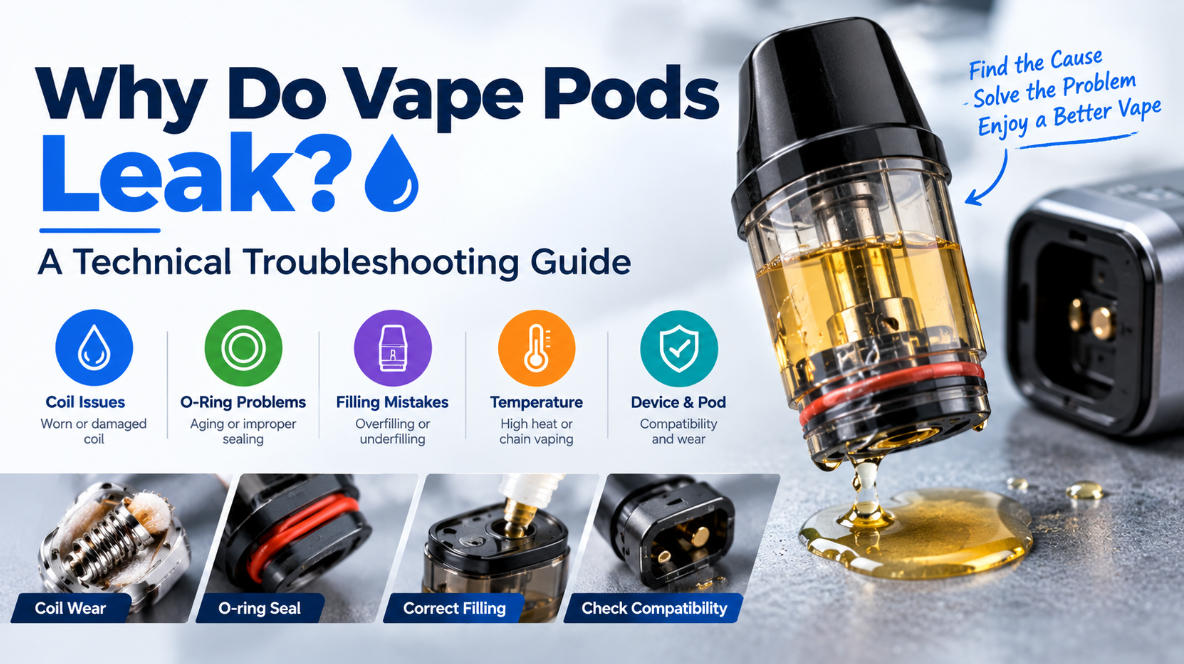
A leaking vape pod can have several causes, including a damaged seal, an incorrectly seated pod, overfilling, condensation mistaken for a leak, unsuitable storage or a component defect. The exact cause depends on the device design, pod condition and instructions supplied by the manufacturer. Buyers should avoid assuming that every leak has the same explanation.
This guide provides general troubleshooting and supplier-evaluation information. Always follow the device manufacturer’s instructions. Do not continue using a device that is damaged, unusually hot or otherwise appears unsafe.
1. Distinguish leakage from condensation
Small amounts of moisture around an airflow path or mouthpiece may be condensation rather than liquid escaping from the reservoir. Look for the location, frequency and amount of fluid, and compare it with the manufacturer’s guidance. If liquid repeatedly appears outside the pod or device, treat it as a potential leak and investigate rather than dismissing it as normal.
2. Check fit and component condition
A pod that is not fully seated, a cracked reservoir, a worn seal or damage around a connection can affect containment. Inspect only as directed by the manufacturer. Do not force components together or attempt improvised repairs to sealed electronic parts. If the pod or device is damaged, stop using it and follow the supplier’s replacement or support process.
3. Review filling and storage instructions
Refillable products may have specific fill limits, fill-port procedures and waiting instructions. Overfilling or failing to close a fill port correctly can contribute to leakage on some designs. Temperature changes, pressure changes during transport and storage orientation may also affect certain devices. Follow the exact product instructions rather than applying a universal rule to every pod system.
4. Consider compatibility and product variation
Pods that appear similar are not necessarily designed for the same device. A mismatch can affect fit, sealing or electrical contact. Buyers should request a written compatibility matrix and test the exact device-pod combination. For commercial orders, verify that the tested samples, approved specification and delivered production version match.
5. What distributors should ask manufacturers
- How are seals, fill ports and reservoir components inspected?
- Are leakage-related acceptance criteria documented?
- Are product samples tested under defined conditions, and are those conditions recorded?
- How are production lots identified and complaints traced?
- What is the process for investigating recurring leakage and documenting corrective action?
- How are design or component changes communicated to customers?
A statement such as “leak-proof” should be supported by a clear definition and relevant test evidence. Buyers should ask what conditions were tested and what the results actually establish.
6. A simple issue log
| Record | Why it helps |
|---|---|
| Model and pod revision | Confirms the exact configuration |
| Batch or lot code | Supports traceability |
| Leak location and frequency | Helps distinguish recurring patterns |
| Storage and handling conditions | Provides context for investigation |
| Photos and support case number | Helps the supplier assess the reported issue |
Frequently asked questions
Can a leaking pod always be fixed by cleaning it?
No. Cleaning may remove external residue but cannot correct a damaged seal, cracked pod or design defect. Follow manufacturer instructions and replace damaged components through the approved process.
Does leakage automatically mean the whole device batch is defective?
Not necessarily. A single report does not establish the cause or scope. Record the issue, identify the model and lot, and ask the supplier to investigate using documented procedures.
What should a wholesaler request before placing a large order?
Request the approved specification, relevant inspection criteria, evidence for leakage-related claims, traceability details and the complaint/corrective-action workflow.
Conclusion
Reliable leakage investigation starts with the exact product configuration, a clear record of the issue and a documented supplier response. For B2B buyers, the goal is not to accept broad marketing promises but to understand how the design is checked, how production is controlled and how problems are resolved.
For manufacturer capability discussions, see the verified ROCKMEVAPE OEM/ODM page.
more info: When to Change a Vape Coil: Signs, Causes and Maintenance Factors