 English
 French
 German
 Italian
 Polish
 Russian
 Spanish
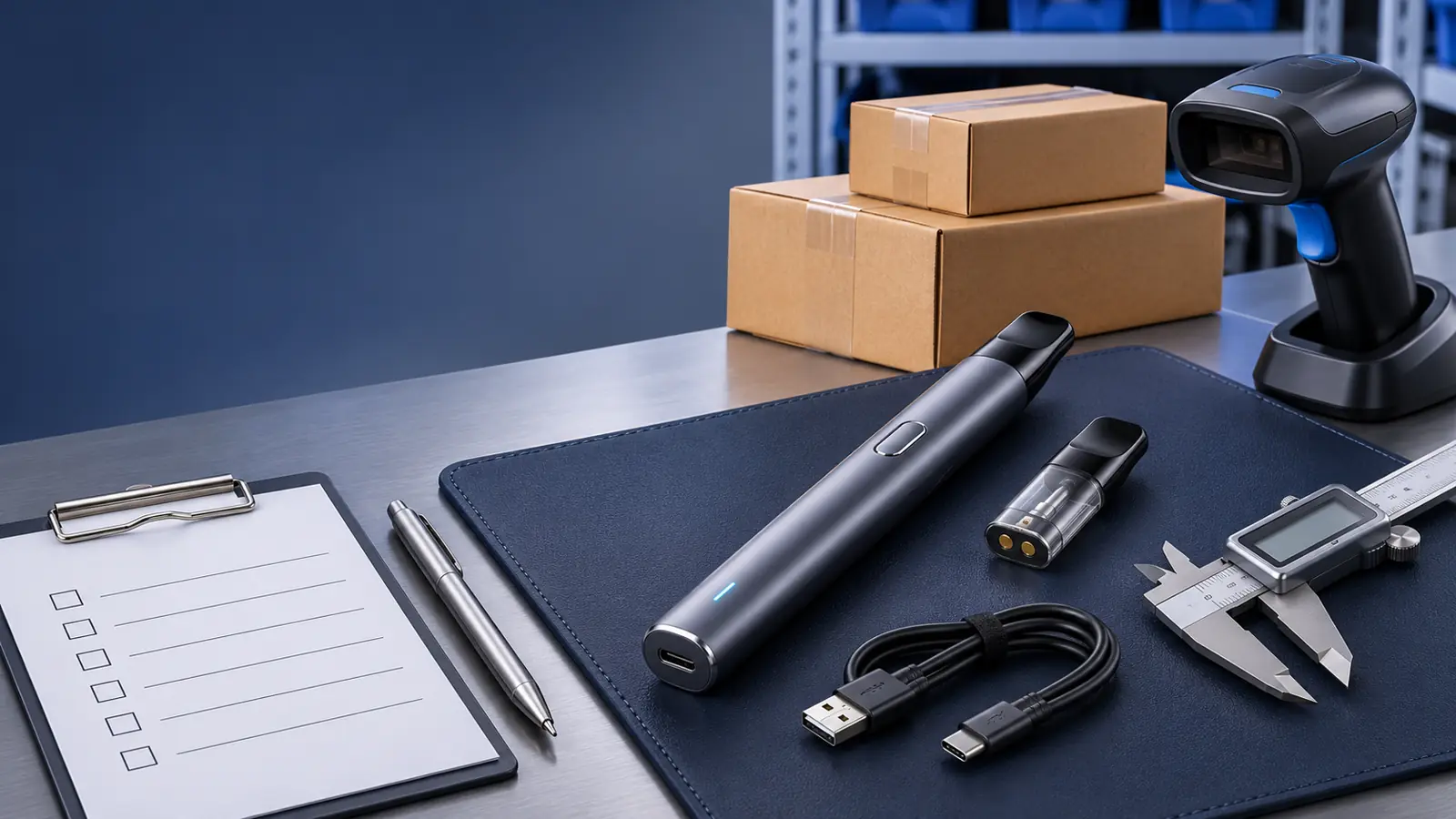
A vape pen rechargeable device is a pen-shaped electronic vaping product with a battery that can be recharged. That description does not tell a wholesale buyer whether the liquid system is refillable, whether the device is intended for repeated use, how the battery and charging circuit were validated, or whether the exact product may be supplied in the United States or a European destination. Those questions must be answered separately at SKU level.
This guide is for wholesalers, distributors, importers, retailers, and OEM/ODM buyers comparing rechargeable pen-style devices for lawful adult markets. It focuses on specification evidence, product classification, charging and battery controls, shipment planning, and market-specific documentation—not consumer use or health claims.
What Buyers Mean by “Vape Pen Rechargeable”
Search results for this phrase mix several different products:
- Rechargeable closed systems: a reusable battery works with prefilled compatible cartridges or pods.
- Rechargeable refillable pens: the battery powers a tank or pod that the user can refill.
- Rechargeable integrated-liquid products: the battery can be charged, but the liquid container is not intended to be refilled or replaced.
- 510-style batteries: pen-shaped power units intended for compatible cartridges, subject to the intended use and destination’s product classification.
“Rechargeable” describes the power source. It does not prove that the device is reusable, refillable, compliant, authorized, or suitable for a particular cartridge. A purchase specification should state the product architecture rather than relying on the search phrase alone.
Rechargeable, Refillable, and Reusable Are Different Claims
| Claim | What it should mean | Evidence to request |
|---|---|---|
| Rechargeable | The internal or removable battery accepts an electrical charge. | Rated input, battery specification, charge-control design, instructions and test records |
| Refillable | The liquid reservoir is designed to be refilled. | Filling method, compatible liquid range, leak-control design and user instructions |
| Reusable | The product or core device is designed for multiple use cycles. | Replaceable consumables, expected service conditions, maintenance and end-of-life criteria |
| Rechargeable disposable | The battery can be charged, but the device may still be discarded when its integrated liquid is depleted. | Product construction, instructions and destination-specific legal classification |
These distinctions affect inventory planning. A closed pod system needs continuing pod availability; a refillable pen needs compatible replacement parts; an integrated-liquid device creates a different warranty and end-of-life profile.
Core Specifications for a Wholesale RFQ
A useful request for quotation should require one controlled specification sheet per SKU. At minimum, define:
- product architecture and intended use;
- device, pod, cartridge, tank, and coil compatibility;
- battery chemistry, nominal capacity, voltage, and watt-hour value;
- charging input, connector type, recommended power source, and cable inclusion;
- charge-control, over-current, over-voltage, short-circuit, and temperature protections claimed;
- activation method, power output, cut-off behavior, and indicator logic;
- reservoir or cartridge capacity and whether it is prefilled or empty;
- coil resistance and material specification;
- dimensions, weight, materials, color variants, and pack configuration;
- lot coding, serialisation where used, warranty, and replacement-parts policy.
Do not compare two quotations until their configuration is aligned. A low unit price may omit the cable, replacement cartridge, retail pack, test documentation, or warranty support included in another offer.
Battery and Charging Evidence
A product photo showing a USB port is not a charging-safety file. Wholesale buyers should ask the supplier to explain how the cell, charging circuit, enclosure, firmware or control logic, cable, and instructions were evaluated as one system.
Useful Verification Questions
- Who manufactured the cell, and how is the cell lot linked to finished-device lots?
- What are the rated charging input and maximum charging conditions?
- How does the device respond to over-current, short circuit, abnormal temperature, or a damaged cable?
- What test method supports any advertised charge-time or battery-capacity claim?
- How many samples were tested, and what were the acceptance criteria?
- Does the enclosure show swelling, excessive heat, port damage, or liquid ingress after testing?
- How are returned batteries isolated, investigated, and transported?
Capacity should be checked as a measured electrical property, not inferred from device size. A larger printed milliamp-hour figure is not automatically evidence of longer real-world service because output settings, coil resistance, power losses, use pattern, and cell condition also matter.
US Market: Product Authorization Comes Before the Purchase Order
The U.S. Food and Drug Administration regulates electronic nicotine delivery systems, including components and parts of ENDS while excluding accessories as defined by the agency. For a rechargeable pen sold as part of an ENDS product, buyers must identify the exact device and compatible consumables covered by the claimed marketing basis.
FDA states that authorized e-cigarette products are the e-cigarette products that currently may be lawfully sold in the United States. Authorization is product-specific. A manufacturer registration, pending application, submission number, or authorization for a different device configuration does not establish that the quoted SKU is marketable.
Before ordering for the United States:
- record the exact product name, model, configuration, nicotine variant, and packaging;
- check the current FDA authorized-products resources and searchable database;
- match the claimed product to the order or database entry rather than to a general brand name;
- review state and local licensing, tax, flavor, product-directory, online-sale, and delivery rules;
- confirm retail controls for customers aged 21 and older and the applicable ID-verification process.
A technical test report cannot replace FDA marketing authorization, and an FDA order does not replace battery, transport, state, or commercial due diligence.
European Union: TPD Scope and National Rules
Article 20 of Directive 2014/40/EU establishes requirements for electronic cigarettes and refill containers, including notification and product, information, packaging, and reporting obligations. Member states implement and enforce those requirements, and national rules can add restrictions or procedures.
For a rechargeable pen, the compliance path depends on what is being placed on the market. A battery-only unit, an empty refillable device, a prefilled cartridge system, and a nicotine-containing integrated device may not have identical files. Buyers should map every supplied component and pack configuration to the legal definitions used in the destination country.
Evidence for European Distribution
- destination-country notification details where applicable;
- exact device and liquid configuration covered by the notification;
- ingredient, emissions, toxicological, and nicotine data where required for the relevant product;
- packaging, leaflet, warning, and language files;
- child- and tamper-resistance and leakage-control evidence where applicable;
- electrical, chemical, material, and environmental documentation relevant to the device;
- economic-operator, traceability, vigilance, and corrective-action information;
- national registration, fee, age, flavor, tax, and sales-channel requirements.
For broader destination planning, review ROCKME’s European vape compliance guide for importers.
Lithium Battery Transport Is a Separate Workstream
Rechargeable vape pens usually contain lithium batteries. The U.S. Pipeline and Hazardous Materials Safety Administration notes that lithium cells, batteries, and battery-powered devices are subject to transport requirements that depend on battery type, configuration, size, condition, packaging, and mode of transport.
Before shipping wholesale cartons, confirm:
- the cell or battery identity and watt-hour rating;
- whether the battery is installed in equipment, packed with equipment, or shipped separately;
- the test summary and transport documents required for the shipment;
- protection against short circuit, movement, and accidental activation;
- marking, label, package, quantity, and mode-specific requirements;
- carrier acceptance rules and procedures for damaged or returned units.
A carrier accepting one shipment does not prove that future shipments or other configurations meet every requirement.
Supplier and Sample Validation Checklist
| Stage | Buyer action | Output |
|---|---|---|
| Definition | Freeze the exact device, pod, liquid, cable, pack and destination | Controlled SKU specification |
| Regulatory screen | Confirm the product classification and market-access route | Country-specific evidence matrix |
| Document review | Match reports and declarations to the exact model and component versions | Approved document register |
| Sample test | Check charging, activation, leakage, fit, indicators, temperature and basic durability | Sample inspection report |
| Pilot order | Receive a limited commercial batch and repeat incoming checks | Batch acceptance record |
| Scale-up | Monitor defects, returns, supplier changes and regulatory status | Ongoing performance file |
Use the vape manufacturer quality-control checklist to expand the factory and batch review. Buyers comparing open systems can also consult the refillable vape pen guide.
Incoming Inspection for Rechargeable Vape Pens
A receiving plan should define the sample selection, tools, limits, and disposition rules before the goods arrive. Depending on the product and buyer’s technical capability, checks can include:
- carton, SKU, quantity, batch, and packaging identity;
- device dimensions, weight, finish, connector, and component fit;
- initial activation and indicator behavior;
- charging-current behavior using an appropriate test setup;
- abnormal heat, odor, swelling, port movement, or enclosure damage;
- pod seating, contact cleanliness, leakage, and airflow consistency;
- label, leaflet, warning, barcode, and language accuracy;
- traceability of inspected samples to the supplier’s batch records.
Quarantine any lot that does not match the approved specification. Do not solve a mismatch by quietly updating the product sheet after receipt.
Total Cost of a Rechargeable Pen Program
The device price is only one part of the commercial model. Buyers should include:
- compatible pods, cartridges, coils, tanks, cables, and replacement parts;
- notification, authorization, testing, translation, and packaging costs;
- battery transport, dangerous-goods handling, freight, insurance, and customs;
- defect allowance, warranty replacements, returns, and disposal;
- inventory split across device colors and consumable variants;
- the risk that a core device or consumable is discontinued before stock sells through.
A platform with fewer compatible consumables may be easier to control than a large assortment with fragmented demand. Review the full system economics rather than margin on the starter device alone.
Frequently Asked Questions
What is a vape pen rechargeable device?
It is a pen-shaped vaping device whose battery can be recharged. The term does not establish whether the liquid container is refillable, replaceable, integrated, or legally marketable in a destination.
Is every rechargeable vape pen reusable?
No. Some devices can recharge the battery but are discarded when an integrated liquid supply is depleted. Buyers should verify the construction and destination-country classification.
What battery details should a wholesaler request?
Request the battery chemistry, capacity, voltage, watt-hour value, cell source, charging input, protection design, test evidence, lot traceability, instructions, and transport information for the exact device.
Can a rechargeable vape pen be sold in the United States?
Only after the exact product and transaction satisfy applicable federal, state, and local requirements. Check the current FDA marketing status for the specific ENDS product; do not rely on a supplier’s general “FDA registered” claim.
Does a rechargeable vape pen need an EU notification?
It depends on the product’s construction, contents, role, and destination implementation of the Tobacco Products Directive. Map the exact device, cartridge, liquid, and pack configuration before deciding which notifications and files apply.
Are USB-C rechargeable vape pens automatically safer?
No. A connector type does not establish the quality of the cell, charging circuit, protection logic, cable, enclosure, instructions, or manufacturing controls.
How should importers test a first order?
Approve a controlled specification, review matched documents, inspect representative samples, place a limited pilot order, and repeat incoming checks at batch level before scaling.
Official Sources
- FDA: E-Cigarettes, Vapes and Other ENDS
- FDA: Authorized E-Cigarette Products
- EUR-Lex: Directive 2014/40/EU
- PHMSA: Lithium Battery Guide for Shippers
- PHMSA: Transporting Lithium Batteries
Regulatory note: This article provides general B2B information, not legal advice. Requirements and product status change. Verify the exact SKU, contents, destination, supply chain, and current official records before ordering or shipping.
For a destination-specific rechargeable device project, contact ROCKME VAPE with the intended market, device architecture, cartridge or liquid configuration, target quantity, and required documentation. No product should be treated as market-ready until its exact configuration has been assessed.