 English
 French
 German
 Italian
 Polish
 Russian
 Spanish
Before shipping an e-cigarette product into a European market, importers should confirm the exact product configuration, identify the responsible economic operators, collect the relevant documents and check both EU-level rules and destination-country measures. A supplier statement alone is not enough to establish that a specific product can be placed on a specific market.
This article is a procurement workflow, not legal advice. For the broader legal framework, consult ROCKMEVAPE’s existing European vape compliance requirements guide and verify the latest rules with the competent national authority.
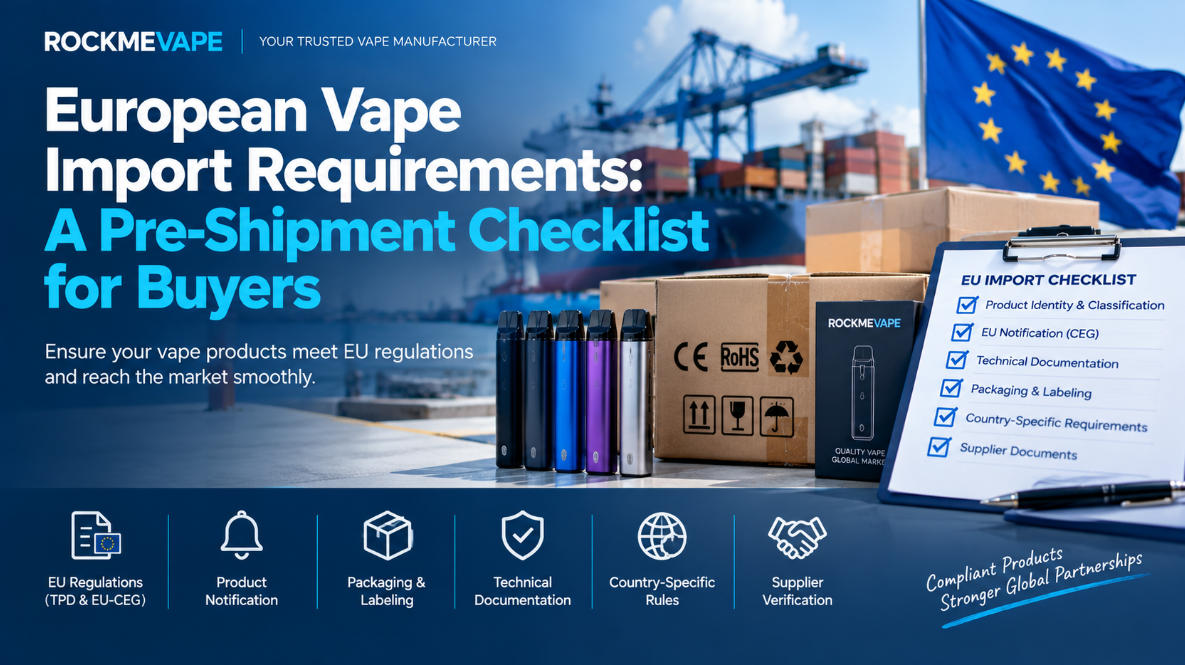
1. Freeze the product configuration
Make sure the purchase order, sample, specification sheet, packaging artwork and supplied documents refer to the same model and revision. Record the product type, pod or tank configuration, liquid volume, nicotine concentration where relevant, battery and charging details, label version and batch identification. Do not assume that a document for a similar model automatically covers the ordered configuration.
2. Check the applicable EU framework
Article 20 of the Tobacco Products Directive 2014/40/EU sets requirements for consumer e-cigarettes and refill containers, including product notification and requirements concerning composition, packaging, labelling, child resistance, leakage protection and nicotine limits for products within scope. Product classification and applicable legislation should be confirmed for the specific item.
Official starting points are the European Commission’s electronic-cigarette overview, the text of Directive 2014/40/EU and the Commission’s EU-CEG step-by-step guide.
3. Verify notification information
Ask for the relevant product notification information and identify which entity is responsible for submission in each destination country. The Commission explains that notification is generally required six months before placing new or substantially modified products on the market under the TPD framework. Confirm the current process, product scope and status with the competent authority; do not treat an email receipt as blanket authorisation for every country.
4. Review packaging and language
Compare the final artwork with the requirements for the destination market. Check required warnings, ingredient and nicotine information where applicable, batch details, leaflet content, responsible-party information and required local-language elements. Confirm that promotional claims or visual elements do not conflict with applicable rules.
5. Check national restrictions before dispatch
EU-wide rules do not harmonise every issue. Member States may have additional measures affecting flavours, sales channels, packaging, taxes or specific product categories. The European Commission publishes notifications of national measures under the TPD. Review the current official record and national legislation before accepting the shipment, especially where restrictions on disposable products or particular configurations may apply.
Do not infer market eligibility from a product’s presence in another EU country. Keep a dated country-by-country check for every destination in the order.
6. Assemble a pre-shipment document pack
| Check | Evidence to collect |
|---|---|
| Product identity | Approved specification, model/revision and purchase-order match |
| Notification | Relevant country/product notification status, verified with responsible party |
| Packaging | Final artwork and language review |
| Quality | Applicable test reports, batch records and traceability details |
| National rules | Dated review of destination-country requirements |
| Logistics and tax | Import, excise, customs and transport requirements confirmed by qualified advisers |
Frequently asked questions
Does EU compliance automatically mean a product can be sold in every Member State?
No. EU-level requirements coexist with national measures and differences in areas not fully harmonised. Check the destination country and exact product configuration.
Can an importer rely only on the manufacturer’s declaration?
No. The importer should review relevant documents, confirm responsibilities and obtain independent professional advice where the legal position or product classification is uncertain.
When should the compliance check happen?
Begin during supplier qualification and repeat it before shipment, whenever the product changes, and when national rules are updated.
Conclusion
A repeatable pre-shipment checklist helps buyers catch mismatched product versions, incomplete documents and destination-market issues before goods move. Keep dated records, identify who is responsible for each requirement and pause shipment when a material point remains unverified.