 English
 French
 German
 Italian
 Polish
 Russian
 Spanish
A refillable nicotine vape is a reusable electronic vaping system whose reservoir can be replenished with nicotine-containing e-liquid. For wholesalers, distributors, and importers, it is not one SKU but a connected product system: the battery device, refillable pod or tank, coil, refill bottle, packaging, and replacement supply must work together and satisfy the destination market’s rules.
Search results often focus on consumer questions such as ease of use, flavor choice, or operating cost. A B2B buyer needs a different answer: which configurations are genuinely refillable, which liquids are compatible, what documentation applies to each component, how replenishment will be maintained, and whether the exact device and nicotine liquid may lawfully enter the intended market.
What Counts as a Refillable Nicotine Vape?
In a true refillable system, the user can add compatible e-liquid to a pod, cartridge, chamber, or tank designed for repeated use. The battery is normally rechargeable, and the heating element may be integrated into the pod or separately replaceable.
| Format | Liquid supply | Replacement model | Key B2B issue |
|---|---|---|---|
| Open refillable pod | User fills the pod from a bottle | Pod or coil replaced periodically | Liquid/device compatibility and leakage control |
| Refillable tank device | User fills a larger tank | Separate coil and other consumables | Coil range, power compatibility, and component support |
| Closed prefilled pod system | Factory-filled replacement pods | Pod replaced, not refilled by user | This is reusable hardware but not an open refillable liquid system |
| Rechargeable non-refillable device | Liquid cannot be replenished | Whole device discarded after liquid depletion | A charging port alone does not make it refillable or reusable |
Product names such as “rechargeable disposable,” “refillable bar,” or “big puff” do not settle the classification. Review the physical filling method, battery, coil, replacement parts, and official destination definition.
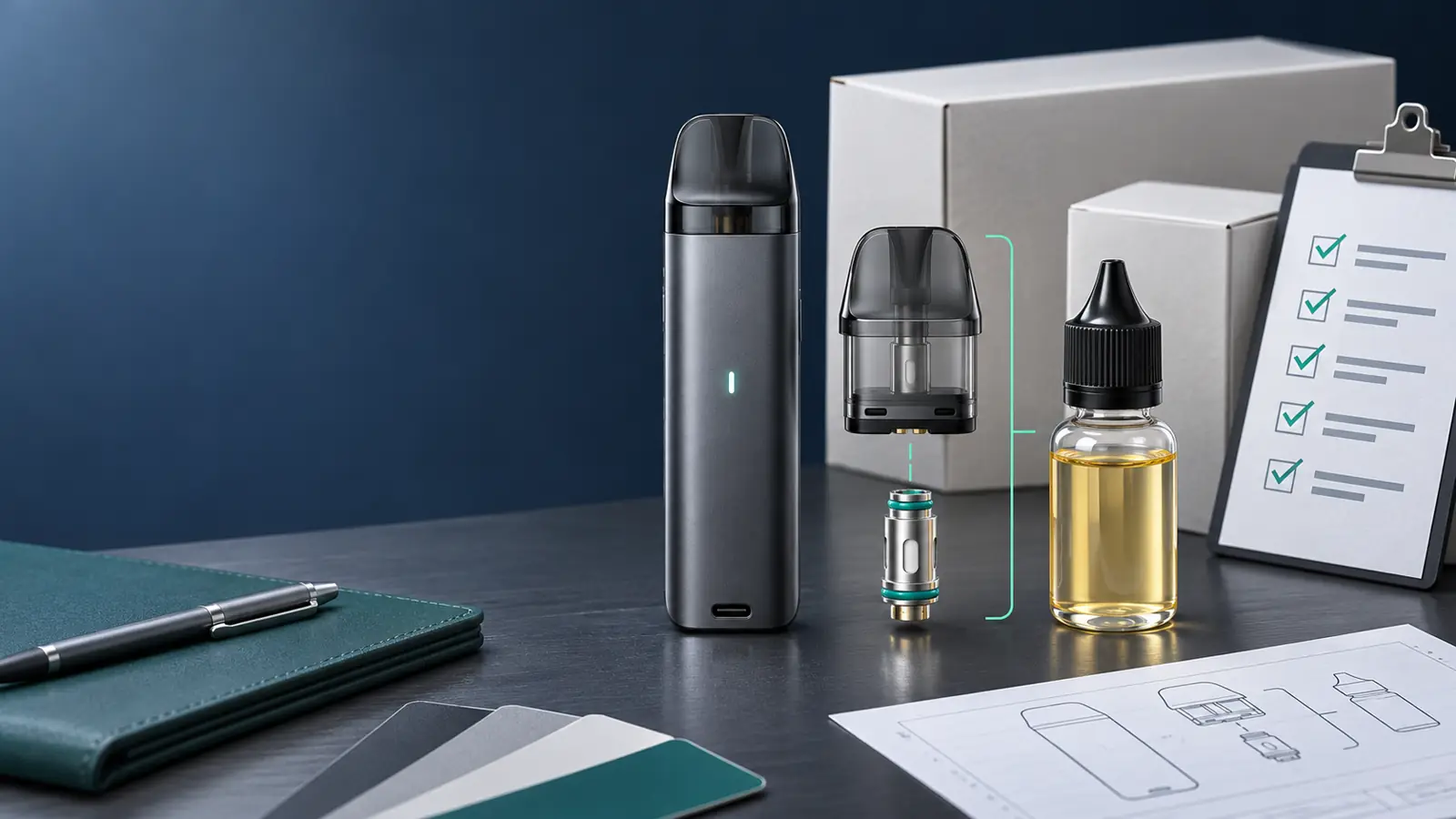
The Four-SKU System Buyers Must Qualify
1. Battery Device
Record the charging specification, battery information, output modes, protection functions, connector design, firmware behavior where relevant, and compatibility range. A device should be tested with the intended pods and coils, not only powered on in isolation.
2. Refillable Pod or Tank
Verify stated capacity, fill-port design, seals, materials, connection tolerances, airflow, visibility of remaining liquid, and resistance to leakage under storage, transport, and use conditions. Confirm whether the pod includes an integrated coil or accepts a separate one.
3. Coil or Heating Assembly
Confirm resistance, materials, operating range, wicking specification, lot traceability, and availability. A product launch can fail commercially if the device remains in stock but compatible coils or pods are unavailable.
4. Nicotine E-Liquid
Treat every formulation, nicotine strength, bottle size, and flavor as a defined SKU. Request ingredient and emissions information appropriate to the destination, nicotine concentration verification, batch identification, packaging specifications, and change-control records. Never assume that any bottled liquid may be paired with any refillable device.
Build a Compatibility Matrix Before Ordering
A supplier should provide a controlled matrix linking each device to approved consumables:
| Field | What to record |
|---|---|
| Device model/version | Exact hardware revision and charging/output specification |
| Pod/tank | Part number, capacity, fill method, materials, and seal revision |
| Coil | Part number, resistance, recommended operating range, and material |
| E-liquid | Formulation ID, nicotine strength, composition data, and intended device range |
| Acceptance tests | Leakage, connection, filling, aerosol output consistency, and end-of-life criteria |
| Market pack | Language, warnings, bottle size, artwork version, and destination |
Do not rely on statements such as “works with most salt nicotine.” Viscosity, power, resistance, airflow, fill-port geometry, and user handling can affect wicking, leakage, and performance. Approve specific combinations and retain reference samples.
European Union Requirements
Article 20 of Directive 2014/40/EU establishes requirements for nicotine-containing electronic cigarettes and refill containers sold as consumer products in the EU. Among other requirements:
- manufacturers and importers must submit product information before market placement under the applicable notification process;
- dedicated nicotine refill containers may not exceed 10 ml;
- tanks and cartridges may not exceed 2 ml;
- nicotine-containing liquid may not exceed 20 mg/ml;
- ingredients must meet the directive’s purity requirements;
- devices and containers must be child- and tamper-resistant, protected against breakage and leakage, and support leak-free refilling;
- nicotine delivery should be consistent under equivalent use conditions;
- packaging, leaflet, ingredient, nicotine, and warning requirements apply.
The EU framework does not make one notification automatically valid for every altered flavor, strength, hardware revision, or national market. Member states implement the directive and may impose additional tax, flavor, distance-sale, registration, packaging, or environmental requirements.
For a broader range-planning approach, see ROCKME’s refillable vape wholesale guide. Buyers focused on pod construction can also review vape pod types and compatibility.
United Kingdom: Refillable Must Also Be Reusable
The United Kingdom banned the sale and supply of single-use vapes on 1 June 2025. Government guidance says a reusable vape must have a rechargeable battery and a refillable container. If the product has a coil, it must be removable and replaceable. Replacement pods, refill liquid, and replacement coils must be separately available to consumers where applicable.
A device with USB charging but a sealed liquid reservoir may still be single-use. A replaceable prefilled pod can support a reusable device, but that is different from an open pod the user refills from a bottle. Classify each system using its actual construction and consumables.
Since 1 October 2026, UK Vaping Products Duty applies to vaping liquid at £2.20 per 10 ml, including nicotine-free liquid intended for vaping. Importers should include duty, stamps, VAT treatment, and approved supply-chain requirements in their landed-cost model. The device and liquid may have different operational and tax records even when sold as one starter bundle.
United States: Verify Every Product Against FDA Records
FDA defines an open or refillable e-cigarette as one with a reservoir that the user can refill with an e-liquid of their choosing. An e-liquid containing nicotine from any source is a tobacco product under FDA’s authorities.
FDA’s current authorized e-cigarette list contains 48 products and states that these are the only e-cigarettes that may lawfully be sold in the United States. Buyers must check the exact device, pod, and e-liquid product—not merely the category name “refillable nicotine vape.” The existence of a submitted application does not create a general legal safe harbor.
Authorization of one device or cartridge should not be interpreted as blanket permission to combine it with unrelated liquids, pods, or components. State, tribal, and local requirements may also add flavor restrictions, directories, taxes, shipping rules, and retailer licensing.
Nicotine Strength Is a Market Specification, Not a Global Default
Write nicotine concentration in a consistent unit, normally mg/ml, and distinguish it from percentage notation. A value described as “2%” is commonly intended to mean 20 mg/ml, but buyers should require the label, formulation record, and laboratory result to agree rather than convert marketing text informally.
Do not assume a U.S. strength can be transferred to an EU SKU. The EU limit is 20 mg/ml, while U.S. product legality depends on the exact authorization. The same flavor name offered at several strengths creates separate inventory, artwork, testing, notification, and demand-planning questions.
Quality Tests for the Finished Refillable System
- Leakage: upright, side, inverted, transport vibration, temperature cycling, and pressure conditions appropriate to the shipping plan.
- Fill operation: access, nozzle fit, overfill risk, closure durability, and contamination controls.
- Connection: pod retention, electrical contact, repeated insertion, and tolerance across lots.
- Wicking: approved liquid/device combinations across defined use intervals.
- Coil consistency: resistance distribution, assembly inspection, and traceability.
- Battery and charging: relevant electrical checks, charger compatibility instructions, and abnormal-condition protection.
- Nicotine concentration: product-specific analytical result tied to formulation and batch.
- Packaging integrity: child resistance, tamper evidence, leakage protection, labels, and transport pack performance as required.
Testing should use written methods, sample quantities, acceptance limits, and lot identification. A report for a similar product is not evidence for the commercial SKU.
Replenishment Economics: The Device Is Only the Entry SKU
A refillable nicotine vape range creates a multi-SKU replenishment model:
- starter devices generate initial placement;
- pods and coils create replacement demand;
- e-liquid adds flavor and nicotine-strength inventory;
- warranty devices and spare parts support the installed base.
Wholesalers should model attach rate, reorder interval, minimum stock, discontinued-component exposure, and gross margin by system rather than by device alone. Too many pod types or coil resistances can fragment inventory. Too few can leave customers without a suitable replacement.
Ask the supplier for a component-support horizon and change-notification period. If a pod seal, coil, connector, or firmware changes, require compatibility confirmation and a new approval sample before accepting the next lot.
Supplier Documentation Checklist
- legal manufacturer and production-site identification;
- complete bill of materials and controlled version history;
- device, pod, coil, and liquid specifications;
- destination-specific notification or authorization evidence;
- ingredient, emissions, nicotine, electrical, battery, and packaging records applicable to the SKU;
- lot coding and traceability from components to finished goods;
- inspection plans and acceptance criteria;
- change-control and regulatory-impact review;
- complaint, return, corrective-action, and recall procedures;
- replacement-component availability and discontinuation policy.
For supplier qualification, use the refillable pod system supplier checklist. A specification-led comparison is available in the refillable pod vape buyer checklist.
Common Sourcing Mistakes
- Treating “rechargeable” and “refillable” as synonyms.
- Buying a device without securing compatible pods and coils.
- Approving a nicotine liquid independently of the intended hardware.
- Using one compliance file for multiple strengths, flavors, or revisions.
- Assuming EU compliance means automatic access to every member state.
- Assuming a product sold online is authorized in the United States.
- Ignoring UK duty and replacement-part availability.
- Comparing purchase price without defects, warranty stock, and obsolete inventory.
Wholesale Purchase Checklist
- Define whether the system is open refillable, prefilled replaceable-pod, or another format.
- List every device, pod, coil, liquid, strength, flavor, and package SKU.
- Build and approve a controlled compatibility matrix.
- Check exact destination authorization/notification and national restrictions.
- Verify liquid capacity, nicotine concentration, labeling, and warnings.
- Test the finished device-liquid combinations using written acceptance criteria.
- Plan replacement inventory and component support before the device launch.
- Calculate landed cost for the complete system, including duty, tax, defects, and returns.
Buyers preparing a first order can follow ROCKME’s bulk vape procurement process. To discuss a destination-specific system and documentation pack, contact ROCKME VAPE with the target country, device format, pod/coil plan, nicotine strengths, flavors, quantity, and packaging scope.
Frequently Asked Questions
What is a refillable nicotine vape?
It is a reusable vaping system with a reservoir that can be replenished with nicotine-containing e-liquid. The system normally includes a rechargeable device, refillable pod or tank, heating coil, and separately supplied liquid.
Is a rechargeable vape automatically refillable?
No. A device may allow battery charging while keeping the liquid reservoir permanently sealed. Buyers must inspect both the power system and liquid container.
What is the EU nicotine limit for refillable vapes?
For products within Article 20 of the Tobacco Products Directive, nicotine liquid may not exceed 20 mg/ml. Dedicated nicotine refill bottles may not exceed 10 ml, and tanks or cartridges may not exceed 2 ml.
Can refillable nicotine vapes be sold in the United States?
Only exact products with the required FDA marketing authorization may lawfully be sold. Verify the device, liquid, pods, and components against current FDA records and applicable state or local rules.
Can any nicotine e-liquid be used in a refillable pod?
No responsible supplier should make that blanket claim. Device power, coil resistance, liquid composition, viscosity, airflow, and wicking design affect compatibility. Approve named combinations using documented tests.
Are refillable vapes allowed in the UK?
Reusable products can be supplied if they satisfy the official definition and other applicable rules. The device must be rechargeable and refillable, and any coil must be removable and replaceable; relevant replacements must be separately available.
What should a wholesaler order with refillable devices?
Plan the installed system: devices, approved refillable pods or tanks, compatible coils, destination-compliant e-liquids, replacement inventory, warranty stock, instructions, and market-specific packaging.
Official Sources
- FDA: Premarket Tobacco Product Applications for ENDS
- FDA: Current authorized e-cigarette products
- European Commission: Electronic cigarettes
- Directive 2014/40/EU, Article 20
- UK Government: Single-use vapes ban and reusable definition
- HMRC: Vaping Products Duty
Regulatory note: This article is general B2B information, not legal advice. Verify the current rules, official records, and exact product configuration for every destination before ordering or supplying stock.