 English
 French
 German
 Italian
 Polish
 Russian
 Spanish
To choose a refillable pod vape for a product portfolio, start with the specification rather than the product name or appearance. European wholesalers and distributors should compare device-pod compatibility, refill design, battery information, component availability, quality evidence and the documentation required for each destination market.
This article focuses on the technical evaluation checklist. For a broader sourcing overview, see the existing refillable pod vape B2B sourcing guide.
1. Confirm the complete configuration
Record the device model, pod model, refill method, coil arrangement, electrical ratings, charging interface, supported components and specification revision. Confirm whether the pod is refillable, replaceable or integrated with the coil. Do not assume that a device can accept a pod simply because the products share a brand or similar form factor.
2. Evaluate refill and sealing design
Ask for the manufacturer’s filling instructions and information about how the design is checked for leakage under defined conditions. Confirm that the sample matches the final production specification. If a supplier claims a refill mechanism is especially easy to use or resistant to leakage, ask for the test method and the conditions under which the claim was assessed.
3. Review battery and charging details
Request the exact battery specification, charging interface, applicable electrical information and user instructions. Ask which testing and transport documents apply to the product and how the supplier controls component changes. Do not infer battery safety or regulatory compliance from a charging-port type alone.
4. Check consumable availability and compatibility
Confirm the replacement pod or coil part numbers, supported versions, packaging identification and expected replenishment arrangements. Ask how long the supplier expects to support the configuration and how it communicates product changes or discontinuation. Build an inventory plan using confirmed lead times rather than assumptions.
5. Match the documentation to the destination
For nicotine-containing consumer e-cigarettes within scope, EU requirements can include notification, composition, packaging, labelling and other product obligations. National rules may add further requirements. Consult the European Commission’s official overview and verify current requirements for each target country. A specification sheet alone does not prove market eligibility.
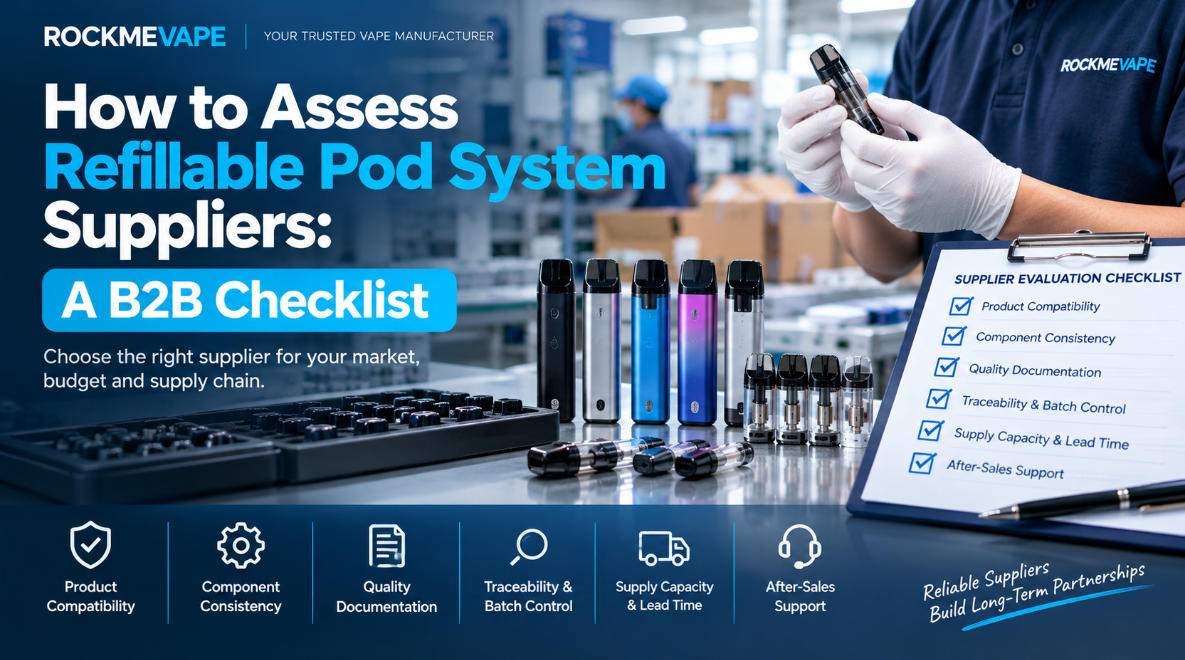
6. Specification checklist
| Specification area | What to record |
|---|---|
| Product identity | Model, revision, manufacturer and configuration |
| Pod and coil | Compatibility, part numbers and replacement options |
| Refill system | Filling method, instructions and applicable test evidence |
| Battery | Rated details, charging information and relevant documentation |
| Quality | Inspection plan, traceability and complaint process |
| Market documents | Product-specific notification and country checklist where applicable |
Frequently asked questions
Which refillable pod vape specification is most important?
There is no single answer. Start with the exact configuration and compatibility, then verify the requirements most relevant to the target customer and market.
Does a higher battery capacity guarantee better performance?
No. Battery capacity is only one specification. Device design, power management, charging requirements and usage conditions also matter.
Can a supplier’s general catalogue replace product documents?
No. A catalogue is useful for discovery, but the buyer should obtain controlled, product-specific specifications and applicable market documentation before ordering.
Conclusion
A refillable pod vape should be evaluated as a complete system: device, pod, refill mechanism, battery, replacement components and market documents. Use a standard checklist across suppliers and resolve any mismatch between sample, specification and intended market before placing an order.
For current models, start with the verified ROCKMEVAPE product catalogue and confirm details with the supplier.