 English
 French
 German
 Italian
 Polish
 Russian
 Spanish
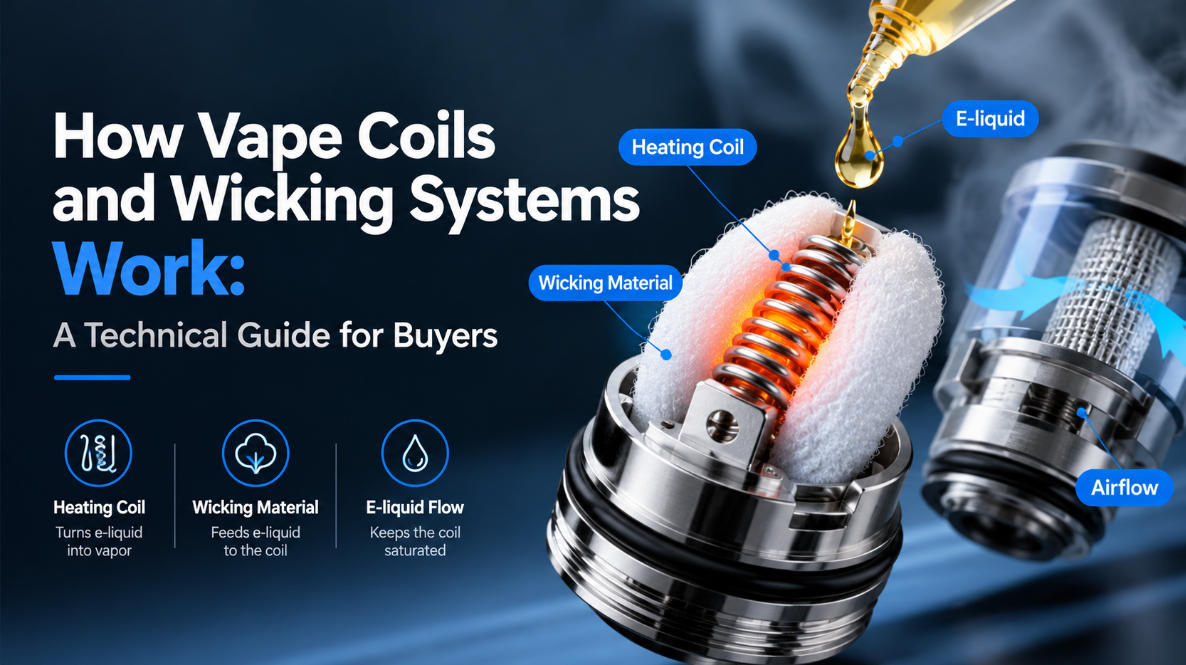
A vape heating coil converts electrical energy into heat, while a wicking system brings e-liquid to the heating area in designs that use a separate wick. The components work together with the device’s power control, airflow path and liquid reservoir. Their exact design differs by product, so technical comparisons should be based on documented specifications rather than names alone.
1. The role of the heating element
When the device activates, current passes through a resistive heating element. The element heats the liquid delivered to it, producing an aerosol. Resistance, material, geometry, power control and airflow are among the variables that influence operation. A single specification, such as resistance, does not by itself establish overall performance.
2. What mesh coil means
A mesh coil uses a mesh-shaped heating element rather than a traditional wire arrangement. The design can change the heating surface and the way heat is distributed, but the result depends on the full assembly, materials, power range, liquid delivery and airflow. Claims about flavour, lifespan or efficiency should be supported by product-specific tests under stated conditions.
3. What the wick does
In systems with a separate wick, the wick transports e-liquid toward the heated area. The wick material, structure, contact with the heating element and liquid properties can affect supply. If liquid delivery does not keep pace with operating conditions, performance can become inconsistent. Different product designs use different arrangements, so there is no one universal wicking specification.
4. How airflow and liquid delivery interact
Airflow carries the generated aerosol through the device’s air path. The heating element, liquid supply and airflow are designed as a system; changing one component can affect the behaviour of the whole device. This is why a replacement coil or pod should only be used with the models and settings approved by the manufacturer.
5. Technical claims buyers should verify
- What material and geometry are specified for the heating element?
- Which device models and power ranges are compatible?
- What wick or liquid-delivery structure is used, where applicable?
- How are component tolerances and batch consistency checked?
- Which tests support claims about flavour consistency, leakage or component life?
- Does the tested sample match the production version and destination-market configuration?
6. A supplier evidence checklist
| Claim | Evidence to request |
|---|---|
| Mesh or coil design | Technical drawing or specification identifying the component |
| Compatibility | Approved model and operating-range information |
| Consistency | Inspection criteria and representative production records |
| Performance | Test method, tested configuration and limitations |
| Change control | Revision history and notice process |
Frequently asked questions
Is mesh always better than a traditional coil?
Not automatically. Performance depends on the full design and test conditions. Buyers should compare verified product data rather than assume one architecture is best for every use.
Does wick material alone determine performance?
No. Liquid properties, wick geometry, assembly, power and airflow all influence the system. Evaluate the complete device rather than one component in isolation.
Can a coil be evaluated separately from the device?
Some component characteristics can be measured separately, but device-level performance and compatibility require evaluation in the intended assembly.
Conclusion
Understanding the relationship between heating, wicking, liquid supply and airflow helps buyers ask better technical questions. The most useful supplier claims are specific, reproducible and supported by evidence that matches the actual product version.
For current product models and manufacturer discussions, visit the verified ROCKMEVAPE product catalogue or OEM/ODM information page.